Category Archives: Books and magazines

The British Newspaper Archive Downgrade

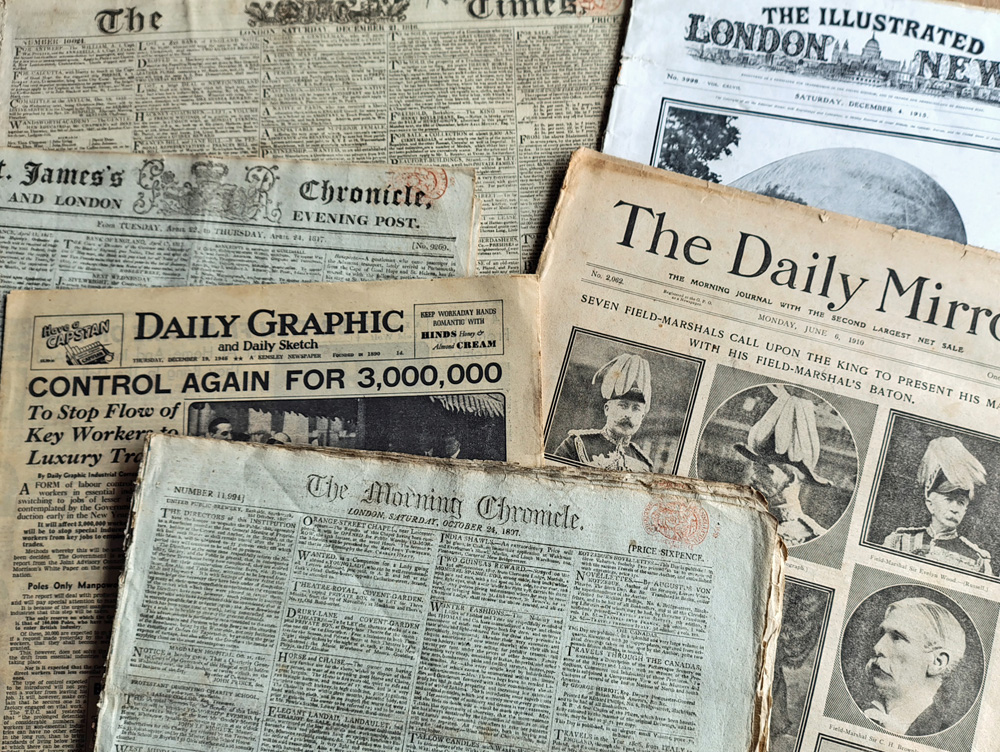
The British Newspaper Archive (BNA) is a monopoly. No other organisation exists that has scanned and made available thousands of historic British newspapers (though they don’t have access to The Times). Before BNA, the main way of looking at newspapers was to go to local libraries and archives, who might hold the actual newspapers or have them on microfilm. Alternatively, it meant a trip to the British Library, whose newspaper library was based at Colindale in north London, with miles of shelving of newspapers and thousands of reels of microfilm. In 2010 the British Library agreed to partner with Brightsolid, a subsidiary of D C Thomson, to digitise their newspapers, and in 2011 the BNA website went live, a joint enterprise between the British Library and the family history website Find My Past (FMP), also owned by D C Thomson. BNA continues to scan and digitise newspapers.

On 28th July 2026, the British Newspaper Archive was deliberately wrecked. Continue reading

Chinese Birds

We are delighted that a new edition of When There Were Birds has been published, in simplified Chinese, translator Feng Chao. The publisher is Beijing United Publishing Co, ISBN 978-7-5596-8978-8. Price 78 yuan.

In China, the Douban Books website is an influential book review platform, and we can see that the reviewers of When There Were Birds reveal that they have understood and appreciated what we set out to do in this social history, saying that it is just as relevant to China as to Britain, with phrases such as “The authors’ narrative is poetic yet profound” and “The Adkins’ strength lies in organizing their material into a compelling social history”.

See our website page for When There Were Birds for more details of this book.


AI or A1?

Just recently it has been impossible to get away from AI (artificial intelligence), because it is being used, abused and debated the world over. Reading about AI is disconcerting, because at a glance it looks like A1, and with some typefaces it is impossible to distinguish between the letter ‘I’ and the numeral ‘1’ (and to add to the confusion, I is the Roman numeral for one).

Classification of ships

In maritime history, A1 referred to the highest classification of seagoing vessels. Lloyd’s Register was founded as a classification society in 1760, and surveyors recorded the condition of vessels. The information was printed in annual Lloyd’s Registers of Shipping, whose abbreviations and symbols changed over the years. The earliest known Register covered 1764–6, when top-quality vessels were classed as AG – the hull being A and the equipment G (for ‘good’). AG later changed to ‘a1’, but the Register for 1775–6 used A1.

In order to keep their class, ships had to be well maintained. Although classification was not compulsory, it was highly desirable, as it facilitated insurance and was a reliable sign of quality, reassuring underwriters, merchants, passengers and crew. Disasters could still happen to A1 shipping, Continue reading

When There Were Birds

Our new book was published in hardback and e-book on 11th November 2021, called When There Were Birds: The forgotten history of our connections. It is available in all superior bookshops and libraries, as well as online retailers. See our website page for details and reviews.

An audiobook will be available in 2022.

“a marvellously original slice of social history” (Daily Mail, Book of the Week)

 “an appealing social history of Britain … [with] a lot of quirky information” (The Independent)

“The facts and folklore of birdlife … are dissected in admirable detail” (The Sunday Times)


Sinking of the Royal George

Our article ‘Royal George: The Sinking of the Royal Navy’s Greatest Warship’ was published in the summer 2020 issue of the online magazine Quarterdeck. This was the disastrous accidental sinking of the Royal George warship at Spithead, off Portsmouth, in August 1782. As well as the loss of over 900 lives, it was also the loss of the flagship that was about to lead a relief convoy to the besieged Rock of Gibraltar. The delay caused by the sinking and its aftermath almost led to Gibraltar being captured by the French and Spanish, but the garrison of the Rock held out.

It was an important incident for British, American and Gibraltarian history, which we feature in Continue reading

Green Park Gates

While in London a year or so ago, we went to Green Park to see a pair of huge blue and gold wrought-iron gates, a Grade II* Listed Building. The gates, which once formed a grand entrance to Green Park, are a reminder that visible traces of history can be much more complex than first impressions. They were originally made for the estate that Lord Heathfield purchased in 1789 to the west of London, at Turnham Green, which was then a small rural village. Heathfield House was demolished in 1837, but the name survives locally as Heathfield Terrace – not much to mark the hero of the Great Siege of Gibraltar, who is better known as George Augustus Eliott.


The Turnham Green gates, now at Green Park

The gates were purchased in 1837 by the Duke of Devonshire for the front of nearby Chiswick House, but in 1897 or 1898 they were moved to the front of Devonshire House in Piccadilly, London. Continue reading

Boz in Oz and Exeter

Charles Dickens is a constant favourite. Some weeks ago, we received a copy of Boz in Oz, the wonderfully named annual journal of the New South Wales Dickens Society in Australia (‘Oz’, of course, meaning Australia, while ‘Boz’ was Dickens’s pen-name). What a treat – 86 pages of beautifully presented articles, news, snippets and reviews, illustrated with loads of colour and black-and-white pictures. It is surely worth joining the society for its journal alone. We have an article in it called “Mile End Cottage, Alphington” (pp. 73–5, with footnotes on p. 86).

Rural banishment

Dickens never had a good relationship with his parents, mainly because he had to constantly Continue reading

Portsdown Lodge

Jane Austen had two naval brothers, Frank (Francis) and Charles. Frank was born at Steventon in Hampshire in 1774, the sixth Austen child, then came Jane in 1775 and finally Charles in 1779. Both brothers became admirals, but Frank eventually rose to Admiral of the Fleet, the highest rank in the Royal Navy, and he ended up living in Portsdown Lodge.

Portsdown Lodge

Being on the north side of Portsdown Hill, Portsdown Lodge was sheltered from the prevailing winds. It had 14 bedrooms, and the estate had farm buildings and several acres of land that extended to the top of the hill, from where Frank could view Portsmouth, its naval base and the Spithead anchorage. Close by was the main route from London to Portsmouth (now the A3). The nearby George Inn, which still survives (shown here), was a coaching inn on this busy route.

Continue reading

John Singleton Copley

The birthplace of the Anglo-American artist John Singleton Copley was Boston, Massachusetts.Born in 1738 (or possibly 1737) to Irish immigrants, Copley became a successful artist in Boston and New York, but left for England in June 1774, followed by his family a year later, in order to escape the political turmoil on the eve of the American War of Independence.

St John the Baptist Church at Croydon in 1785, where John Singleton Copley was buried

He became one of the foremost artists in London and spent more than five years on the huge Continue reading