
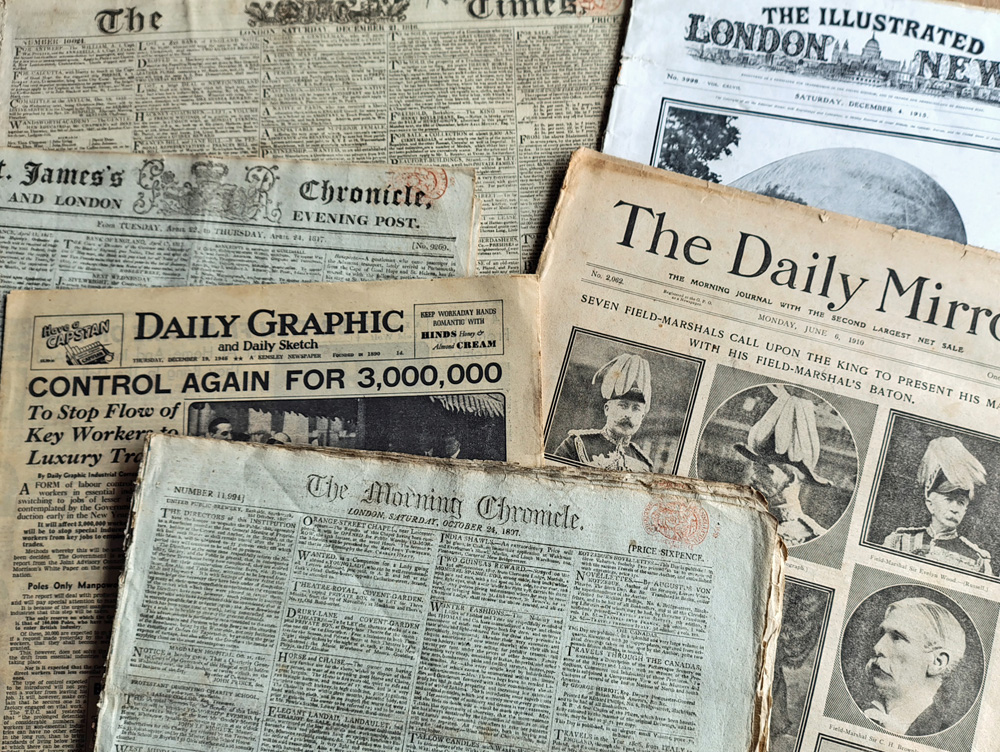
 The British Newspaper Archive (BNA) is a monopoly. No other organisation exists that has scanned and made available thousands of historic British newspapers (though they don’t have access to The Times). Before BNA, the main way of looking at newspapers was to go to local libraries and archives, who might hold the actual newspapers or have them on microfilm. Alternatively, it meant a trip to the British Library, whose newspaper library was based at Colindale in north London, with miles of shelving of newspapers and thousands of reels of microfilm. In 2010 the British Library agreed to partner with Brightsolid, a subsidiary of D C Thomson, to digitise their newspapers, and in 2011 the BNA website went live, a joint enterprise between the British Library and the family history website Find My Past (FMP), also owned by D C Thomson. BNA continues to scan and digitise newspapers.
On 28th July 2026, the British Newspaper Archive was deliberately wrecked.
The British Library’s own website says: “Our partnership with Findmypast on the British Newspaper Archive is a cornerstone of our mission to open up historical research to people everywhere. By bringing millions of pages of digitised newspapers into a single platform, the British Newspaper Archive has enhanced how researchers, family historians and curious minds explore the past. Whether you’re tracking social change through the decades, uncovering forgotten voices, or simply following a hunch from a century ago, we’re so proud of this resource that truly brings history to life.” Beth Gaskell (Lead Curator, News & Moving Image at the British Library)
Who uses it?
Although FMP jointly runs BNA, family historians are probably only a small fraction of their researchers. BNA and British Library must know who its users are. Until recently, BNA has been an invaluable resource for historians and researchers of all kinds worldwide, while some subscribers simply liked to delve into newspapers for enjoyment.
How to subscribe?
It is free to use on computers within the British Library reading rooms. FMP has a version of BNA, but strangely it is an inferior product. It can also be accessed free via other subscriptions, such as the London Library, because libraries can pay an institutional subscription. An annual personal subscription to BNA is in excess of £100, or else there is a pay per view option (about 50P per page). Many of us have had two subscriptions, one to FMP and one to BNA.
Why the downgrade?
In July 2026 BNA excitedly reported that it had upgraded their website, with no prior warning. Except it wasn’t an upgrade, but a disastrous downgrade. There are massive problems, too many to even begin to list here. Everyone is bewildered, upset and angry and asking the question ‘why?’ There are hundreds of calls for the old website to be reinstated, but the impression gained is that BNA has destroyed the old website. We never trusted BNA to curate our work, but many researchers kept their work on the website, which has now been wrecked. We have written to the British Library expressing our consternation, which elicited a pleasant response passing us to BNA! And although BNA sent a lengthy reply, there was no substance to it. They have no sense of urgency, being a monopoly, and are evidently waiting for the fuss to die down, but it actually looks as if subscribers are leaving. Just to give one example, someone asked how they can do a search on illustrations and photographs (something that was easily done on the old website), and BNA’s reponse was: “we have temporarily removed the search filter for illustrations and for photos, as we work on a developing a much more powerful illustration search filter. We do apologise for the inconvenience caused whilst this function isn’t available, and we hope to return it to the site in the coming months.” (our emphasis).
Complaints
Don’t take our word for the disaster. Here are links to some websites where users have voiced their deep concerns. We are sure there must be many more complaints out there, not to mention the many complaints sent directly to BNA and to the British Library. Is anybody listening?
TRUSTPILOT:
This is a review website, and BNA’s rating was 4.8 in mid-July 2026, but has now dramatically dropped to 2.2. Bizarrely, it has recently pulled itself up to 2.3, with several 5-star reviews saying how wonderful Sophie (and others) are in accounts! Actual users of the website give it 1 star. Here’s the link:
https://uk.trustpilot.com/review/britishnewspaperarchive.com
BRITISH NEWSPAPER ARCHIVE FACEBOOK PAGE:
On the BNA Facebook page, their proud announcement of the new website has been met with anger:
https://tinyurl.com/dfmf68nk
One reviewer summed it up: “A complete and utter abomination. The new layout is unwieldy, news items I know are on the database can no longer be found, and searches lead to news articles with words highlighted that bear no relevance to the keywords entered. A complete disgrace. Not so much change for the sake of change, as change for the sake of destruction.”
SCOTTISH GENES BLOG:
This Scottish genealogy site has also registered many complaints:
https://tinyurl.com/mtev3643
RAILWAY HISTORIAN DAVID TURNER:
Dr David Turner, railway historian, also has complaints on his blog:
https://tinyurl.com/epysxbua
BRITISH LIBRARY FACEBOOK:
Ian McCracken sums it up: “What a fiasco. I firmly believe the British Library should intervene.” His, and other comments, on the British Library’s page of the British Newspaper Archive’s Facebook page can be found at:
https://tinyurl.com/bd8k99wf
The future?
We feel deeply sad and powerless about the destruction of the British Newspaper Archive website, with British Library obviously conniving in its destruction. It is bewildering and feels like a good candidate for conspiracy theories. Please add your voice so that the old website is reinstated.